Can You Learn Acting Online as a Complete Beginner?

Yes.
Now that we've handled that, let's talk about the question you're probably actually asking:
"Can I learn acting online if I have absolutely no idea what I'm doing?"
Also yes.
And in some cases, starting online can make the first step considerably easier.

You do not need acting experience to start acting
This sounds obvious, but beginners frequently apologize for being beginners.
"I've never taken an acting class."
Perfect.
That's why acting classes exist.
You are not expected to arrive knowing how to analyze a scene, work with an objective, use your voice correctly, create a character or access emotion on command.
If you already knew all of that, this would be a very strange beginner class.
What should beginners actually learn first?
A good beginner acting program shouldn't immediately throw you into a dramatic scene and tell you to "feel it."
Before worrying about whether your Hamlet is sufficiently tortured, you need foundations.
Relaxation and body awareness
Actors often carry unnecessary tension in the jaw, shoulders, hands, face and breath.
Learning to notice your body is fundamental because your body is part of the instrument you're working with.
Breath and voice
You don't need to develop a giant theatrical voice for every kind of acting.
You do need to understand how breathing, tension and physical habits affect your speech.
Attention and listening
New actors often concentrate so hard on what they are supposed to say next that they stop listening to the other person. Acting gets considerably more interesting when you stop waiting for your turn to speak.
Imagination
Not every emotional moment needs to come from digging through your most painful memories. Actors need imagination, observation and the ability to engage seriously with circumstances that aren't real.
Text and character
Eventually, you learn to stop treating dialogue as words that must be remembered and start asking:
What does this person want?
Why are they saying this?
What happened before the scene?
What changes?
That's where acting begins to become fun.
But don't I need scene partners?
Eventually, yes. Working with other actors teaches listening, timing, adaptation and connection.
But you don't need a scene partner for every part of your training. Many foundational exercises can be practiced individually.
Monologues, voice exercises, body work, observation, imagination, emotional exercises, script analysis and on-camera work can all be trained online.
Private online coaching can therefore be a very comfortable place to begin.
What if I'm shy?
Then acting might be especially interesting for you.
You do not need to become the loudest person in the room. In fact, "confidence" in acting doesn't mean becoming louder, bigger or more extroverted. It means becoming more comfortable being seen.
That takes practice.
One-on-one online training can remove the immediate pressure of performing in front of a group while still requiring you to take creative risks.
At FACTOR, beginners can start with private online classes where the exercises and material are selected specifically for their level. There is no class to "catch up" with.
You're the class.
What equipment do I need?
For most live online acting training, the setup is refreshingly boring.
You generally need:
a phone or computer with a camera
stable internet
enough room to stand and move
a relatively quiet space
water
somewhere to put your device around eye level
FACTOR's live sessions currently run on Zoom and can be joined from a laptop or phone.
No ring light worth $600 is required. You are learning acting, not launching a beauty channel.
How often should a beginner practice?
Consistency matters more than one heroic five-hour acting session followed by three weeks of doing nothing.
If you're taking a weekly class, continue working between sessions.
Read scripts.
Observe people.
Practice your voice.
Repeat exercises.
Learn material.
Record yourself.
Watch performances and ask why they work.
Acting isn't something that happens only while your teacher is watching.
Can a recorded course work for beginners?
Yes, particularly for fundamentals.
The benefit of a self-paced course is repetition. You can pause an exercise, go back and try it again without feeling that you're holding up a class.
FACTOR's Fundamentals of Acting course was designed to work this way. It includes eight lessons covering relaxation, memorization and creative thinking, body language, emotional expression, voice, imagination, sensory awareness and final performance work.
The limitation is feedback. A video cannot tell you what you are doing.
That's why some beginners start with a recorded course and add individual coaching when they want outside feedback.
When should you move into group classes?
When you want to. There is no ceremony. You do not receive a letter saying:
Congratulations. You are now emotionally prepared to interact with other actors.
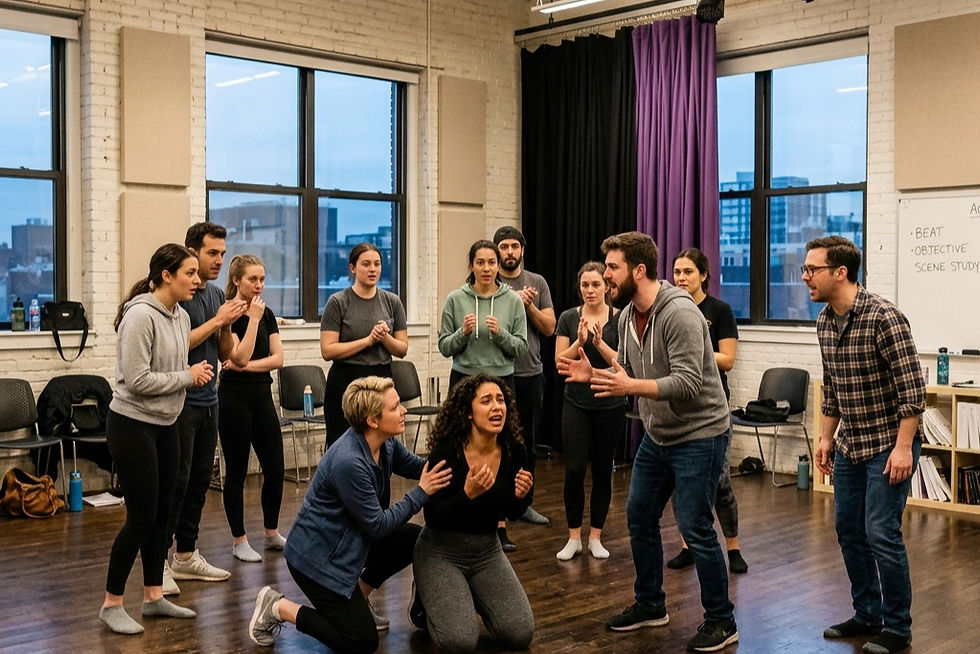
Group classes become particularly useful when you want more scene work, improvisation, ensemble exercises and community.
Private and group training solve different problems, and many actors use both throughout their careers.
Your first acting class isn't an audition
This may be the most important thing to remember.
You do not need to impress your acting teacher.
You don't need to prove you belong there.
And you certainly don't need to be "talented enough" before you begin.
The purpose of training is to discover what you're capable of. Nobody starts playing piano by first demonstrating that they're already excellent at piano.
Acting somehow convinces people the rules should be different.
They aren't.
Start where you are.
That's enough.


Comments